Concept · UX Case Study · 2025
Making the wait legible, not longer
A way to follow an NHS referral — built for the patient who reads silence as a threat.
Informed by my work coordinating NHS outpatient referrals. A concept, not a live system. No real patient data, no Trust-identifiable material.
How to read the evidence in this piece
Documented, or close to a person's own words.
My interpretation of what the evidence means.
A reasoned belief I haven't validated.
A hypothesis I held and could not confirm.
The short version — about 90 seconds
At a glance
The problem
After a GP referral, a patient can see that they're waiting but not where they are in it. The system shows a coarse, undated status against a 14-day expectation it can't meet — so silence fills with the worst explanation.
The insight
The patient who rings on day 15 isn't over-anxious. They're following an instruction — "ring if you've heard nothing in two weeks" — the system can't honour for a routine referral. The chase call is rational compliance with a broken promise.
What research changed
My model didn't survive intact — it got located. Waiting isn't one experience; it's at least three styles. The sharpest finding cut against my own design: the same honest information that helps an anxious patient could manufacture anxiety in one who was coping by not looking.
The design
One orientation view that answers: where am I, is this normal, what's next, do I need to act — offered when the patient seeks it, never pushed. Position is shown as stage, not time, so the wait never becomes a countdown.
Where it ends
Not 'this solved the problem.' I haven't claimed the design works. I built it to be tested, and stated exactly which results would tell me I was wrong.
01 — the observation
A patient can do everything right and still be lost
Coordinating outpatient referrals, I fielded the same call again and again: “I'm just chasing up my referral — I was told to ring if I hadn't heard in two weeks.” The patient had done nothing wrong. A letter or their GP set a 14-day expectation; the system, for a routine haematology referral, can't meet it.
At day 15, silence didn't read as “still in the queue.” It read as “the thing I was promised didn't happen, so something is wrong.” That reframed the problem. The chase call isn't a difficult patient — it's a rational response to a broken expectation. observed
02 — the problem, precisely
Status without orientation
The obvious objection is that the NHS App already shows status. It does — and that's the problem, more than its absence would be. For a triage-based referral it shows a coarse, undated label like “waiting to be booked.” At week six, with no date and no interpretation, the patient can't tell normal from stuck.
The genuine gaps are two: no realistic horizon, and no interpretation of what the status means. observedThe problem isn't a black box — it's information that looks like an answer but doesn't function as one.
03 — the analysis
Where the referral and the patient part ways
I mapped the true system state against the patient's perception across the referral's stages. They diverge at three moments — and at one, they point in opposite directions.
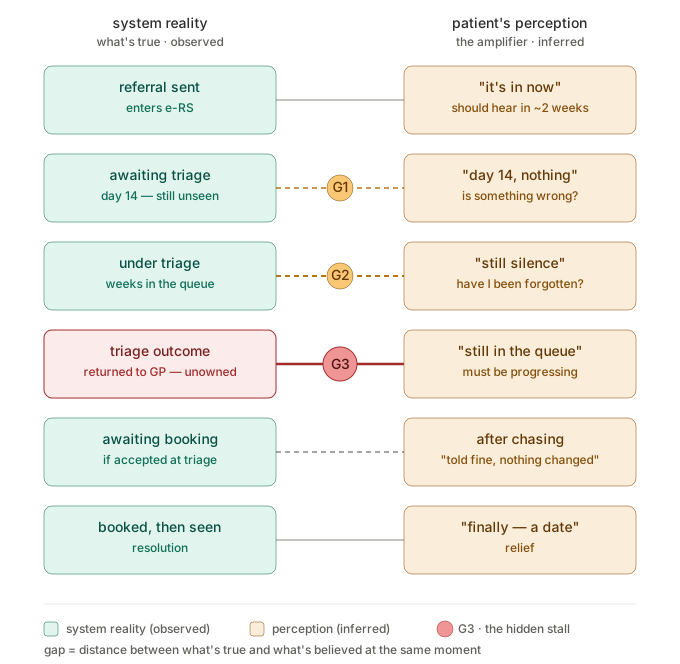
The red moment, G3, is the one I could only know from inside the queue: when triage returns a referral to the GP, it can sit unowned between primary and secondary care. The system has sent it backward— while the patient, seeing nothing change, is the most confident they've ever been that it's progressing. observed That invisible stall becomes a design problem later.
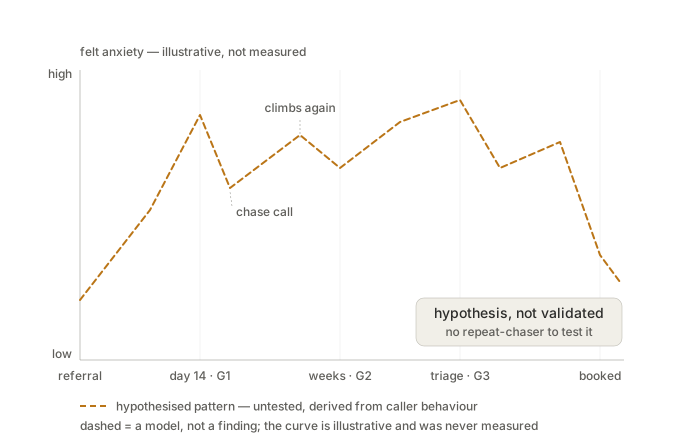
04 — the discipline
Testing the model before trusting it
Before interviewing anyone, I wrote a research contract committing to disconfirmation — naming, in advance, what result would force me to change the model. Then I ran three informal interviews with people in my own network who'd waited for an NHS referral. General referrals, not haematology — so they test the structural waiting experience, not condition-specific fear.
Three people can show that something exists; they can't show how often, or prove anything false. I held that line in both directions — the same discipline against over-claiming disconfirmation as against over-claiming proof.
05 — the finding
Who this is actually for
The interviews didn't confirm my model. They located it. Even three people split into three waiting styles.
The passive truster
Didn't chase. Read silence as "no news is good news."
The uncertainty-amplifier
Monitored constantly. Read silence as a threat.
The process-frustration waiter
Distress came from a missed letter — not health fear.
The amplifier is my persona — corroborated at the structural level, though the haematology-specific fear stays inference. inferredThe other two aren't holes in my model; they're people it was never for, and I'd scoped them out from the start. Finding them is evidence the scoping was real.
Then the finding that mattered most, because it cut against my own design: if the passive truster copes by not engaging with a timeline, an honest horizon could manufacture anxiety in someone who had none. inferred That sharpened the design rather than weakening it: orientation has to be something the patient seeks, not something pushed at everyone.
06 — the design
Orientation, not a countdown
One view, not three screens. It answers four questions — Where am I? Is this normal? What happens next? Do I need to act? — and it's built to be put down, not monitored. Reassurance comes first; the timeframe and the action threshold are demoted to layers the patient opens only if they want them.
What the view really had to solve was its hard states, not its happy path. Two carry the whole concept.
S2 — Long but normal
Long but normal. The number is framed as normal; position is shown as stage; the “why” and threshold are pulled, not pushed.
S4 — Needs checking
The G3 stall, made visible: amber not red, framed as administrative, one clear action, the returned-to-GP stage named on the tracker.
Key design decisions
- Stage, not time — position shown as a pathway stage so the wait is never a countdown to a date that might move.
- Reassurance first — the status card leads with normalisation before surfacing the timeframe.
- Pulled not pushed — the 'why' and action threshold are in expandable layers the patient controls.
- Amber, not red for G3 — the returned-to-GP state is framed as administrative, not a health signal.
- One clear action — when something needs doing, there's a single button and a script for what to say.
07 — the decision
The decision, and how I'd know I'm wrong
I won't claim this works. The two states above rest on bets my own research flagged as open: that an honest horizon orients rather than starts a countdown, and that the exception state reads as process rather than health threat. assumedRendering them doesn't validate them — it makes them concrete enough to test.
The final artefact is the test itself: a proposed evaluation putting S2 and S4 in front of people — amplifiers and passive trusters — against the alternatives the design claims to beat, measuring what people say first and unprompted, with the falsifying results stated in advance. untested
“I designed for one person — the patient who reads silence as threat — and made a specific bet: that telling the truth about an unsatisfying wait, framed as normal and offered rather than pushed, would orient them rather than frighten them.”
I have not claimed it works. I built it to be tested, stated exactly which results would tell me I was wrong, and drew the line between what I know, what I infer, and what remains open. That line — not a number — is the most honest thing I can show.
Limitations — each one a choice
What I didn't prove
One persona, one journey. A focused, defensible argument over a broad, shallow one — and the research evidenced that the other waiting styles are genuinely distinct.
Three network interviews, non-haematology. They validate structural mechanics, not condition-specific fear; every interview claim is kept to existence, never frequency.
Operational, not validated. It comes from the calls I fielded; my interviews didn't reach it. It informs the design under that label.
The digitally-excluded patient. A real, arguably larger problem — a separate project, named rather than hidden.
All durations and thresholds are illustrative. The real version depends on the Trust exposing triage-to-booking times — a stated dependency of the design.